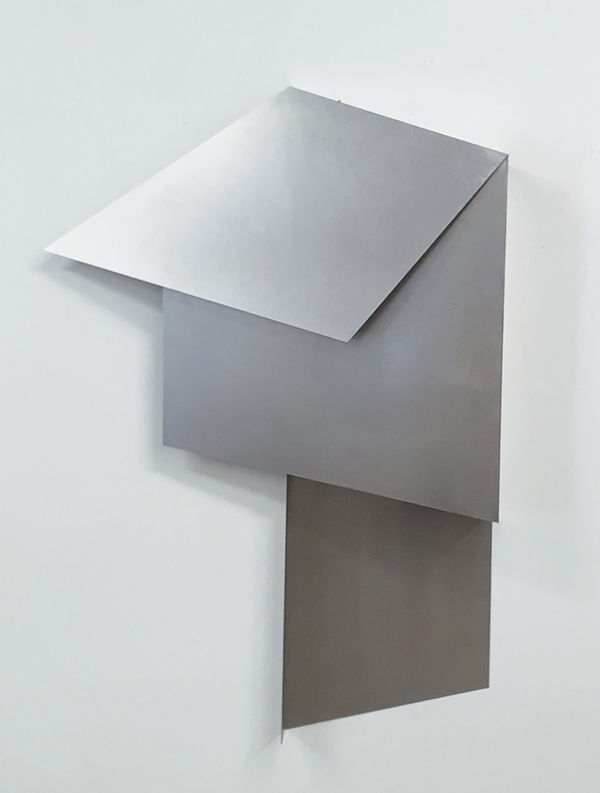
Jeong Jeong-ju
-
Biography
 Caption
Jeongju Jeong explores the interaction between light and space through mediums such as sculpture and media installations. Light becomes a gaze toward a concrete architectural space and functions as a formative element with abstract space.
After majoring in sculpture at Hongik University in 1995, Jeongju Jeong attained the title of Meisterschüler under Professor Hubert Kiecol at the Kunstakademie Düsseldorf in Germany in 2002. He earned his Ph.D. in Art from Kookmin University in 2015 and has been a professor in the Sculpture Department at Sungshin Women’s University since 2012.
Early Years
Jeongju Jeong was born in Gwangju in 1970. On May 18, 1980, He personally experienced the Gwangju Democratization Movement. The memories of the uprising in his childhood are sensory experiences of burning cars in the streets, shattered glass, a paralyzed city, and the distant sound of gunfire at night.
His interest in light began during his unfamiliar student days in Germany. He recalls feeling terrified to the point of dizziness when a sharp beam of light invaded his small room. Afterwards, He started working with light that entered through windows, experimenting with the organic relationship between light and space through various mediums.
-
Exhibitions
Jeong has held several solo and group exhibitions since 2000.
Major solo exhibitions include 《Illuminate》 (2021, Gallery Chosun, Seoul), 《Illumination》 (2020, Kunstverein Haus der Kunst Enniger, Münster, Germany), 《Invisible Light》 (2019, Gallery Chosun, Seoul), "Illusion" (2010, Kim Chong Yung Museum, Seoul), 《City of Gaze》 (2007, Plus Gallery, Nagoya, Japan), 《InsideOut》 (2007, Alternative Space Pool, Seoul), "inner brain" (2003, Gallery Brain Factory, Seoul), 《Schauhaus》 (2003, Gallery Sagan, Seoul), and others.
Key group exhibitions include 《The Second Spring》 (2022, Gwangju Museum of Art, Gwangju), 《When the light comes out of the sun》 (2021, Jeonnam Museum of Art, Gwangyang), 《2020 Gwangju Media Art Festival》 (2020, Asia Culture Center, Gwangju), 《Time Reality》 (2019, Coreana Museum of Art, Seoul), 《Post88》 (2018, Seoul Olympic Museum of Art, Seoul), 《Young Vision, New Perspective》 (2017, Busan Museum of Art), 《Discovery of Space》 (2016, Gyeonggi Museum of modern Art, Ansan), 《The Future is Now》 (2013, National Museum of Modern and Contemporary Art, Gwacheon), 《Thermocline of Art: New Asian Waves》 (2007, ZKM, Karlsruhe, Germany), 《City net Asia 2007》 (2007, Seoul Museum of Art, Seoul), 《Art Spectrum 2006》 (2006, Samsung Art Museum LEEUM, Seoul), 《Electro Scape》 (2005, Zendai Museum of Modern Art, Shanghai, China), and more.
-
Exhibitions
-
Signal on Sale
12 - 26 Nov 2025Read more -
As the Sharp Narrative Fades, A Revealing Map Emerges (PART 2)
명료한 서술을 지우니 또다른 지도가 드러났다. (파트2) 5 Dec 2024 - 25 Jan 2025Read more -
Luminous City
Jeong Jeong-ju 25 Aug - 21 Sep 2023Read more -
INVISIBLE LIGHT
Jeong Jeong-ju 31 Oct - 22 Nov 2019Read more -
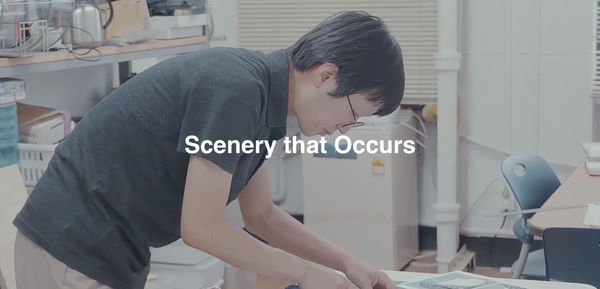
Scenery that occurs
Jeong Jeong-ju 7 Sep - 23 Nov 2017Read more -
scotama
Jeong Jeong-ju 30 Apr - 29 May 2014Read more -
Strange Visit
Jeong Jeong-ju 28 Mar - 10 May 2012Read more -
City of Gaze
Jeong Jeong-ju 7 Jan - 28 Feb 2010Read more
-
-
Records
-
Major Works
Works using architectural models and cameras
During his studies in Germany, Jeongju Jeong experimented with light entering through windows. He traced the shapes of light coming indoors as in "Light shape" (1998), reflected light to create different shapes, or turned sunlight coming through a window at a specific time into wooden structures (1998).
Later, in "schauhaus" (1999), He created an architectural model of his living space and used cameras and videos to visualize the gaze toward the architectural space. In "Dormitory" (2000), He made a model of a student dormitory, installed surveillance cameras inside, and showed the audience the video inside the space through monitors. The video shows the empty interior architectural space, and the audience wandering outside or looking inside, reflecting on the act of seeing and being seen. While expanding the meaning of light into a gaze, Jeong does not merely visualize light but draws out reflections on the act of seeing and the seen, subject and object.
Upon returning to Korea, He enlarged the scale of architectural models to visualize not only the interiors and exteriors of private spaces but also the structure and dynamics between surveillance and gaze in urban spaces. "Dukidong Rodeo Street" (2005), "Zenda Plaza" (2005), and "City of Gaze-Nagoya" (2007) represent parts of urban spaces in architectural model scales, while "Building" (2006) enlarges architectural models to human scale.
By focusing on specific places and architecture as subjects, his work extends to evoke the history and memories, past and present, of specific architectural spaces through the dynamics of gaze. 〈Jeonil Building〉 (2018), 〈(Former) Gwangju National Army Hospital〉 (2019), and 〈Sangmu Office〉 (2019) relate to buildings involved in the Gwangju Democratization Movement, and these works reflect on painful history as well as contemplation on history and the present.
-
-
External Exhibitions-
2019 《Light on the Move》, Asia Culture Centre, Gwangju, South KoreaWhen driving through a dark space at high speed, scattered lights coming from houses or street lamps flash by in the night. As I watch these points of light pass,...
-
2010 《Illusion》, Kim Chong Yung Museum, Seoul, South KoreaJeong-ju Jeong has spent most of his career creating works that explore the structure of contemporary buildings in compelling ways. Through the designs of contemporary architects such as Le Corbusier...
-
2007 《City of Gaze》, Plus Gallery, Nagoya, JapanHotei Hotei, where the exhibition is located in Nagoya, is a neighbourhood made up of traditional Japanese houses from before urbanisation. However, redevelopment was confirmed in 2005, and the old...
-
2007 《Thermocline of Art - New Asian Waves》, ZKM, Karlsruhe, GermanyWhen you enter ZKM through the main entrance, built from a renovated former factory building stretching 350 metres long, the exhibition hall for special exhibitions is on the left. On...
-
2006 《Artspectrum 2006》, Leeum Museum of Art, Seoul, South KoreaBuilding, 2006, A model of Building made of wood and acryl, 4 video cameras, fluorescent lamp, video projector, motor, 300 × 600 × 190cm Audiences wander between two long buildings...
-
2005 《ElectroScape》, Shanghai Zendai MoMA, Shanghai, China
-
2005 《Strange Visit》, Project Space ZIP, Seoul, South KoreaA house is, in physical terms, a relatively small space made up of rectangular structures: windows, and doors. For the people who live inside it, however, it is also a...
-
2004 《Media Art Exhibition - Clash and Flow》, Seodaemun Prison History Hall, Seoul, South KoreaSeodaemun Prison (2004), wood, 4 video cameras, a video projector, 4 motors, 160 × 140 × 120cm This model is made for the exhibition in a prison which is used...
-
2003 《Pleasure Factory》, Seoul Museum of Art, Seoul, South Korea9 video cameras, 9 monitors This model is made after the ‘Pleasure Factory’ exhibition hall which was the project exhibition of Seoul Museum of Art in 2003. Unfinished exhibits are...
-
2003 《Schauhaus》, Gallery Sagan, Seoul, South KoreaThe Interaction Between “Seeing” and “Being Seen” Yoon Jin Sup (Art Critic / Professor at Honam University) Translated by Gallery Chosun Ⅰ. Inside a room, there is a single desk....
-
2000 Kunstakademie Düsseldorf, GermanyDormitory (2000), 200x80x80cm A dormitory model made of wood, 5 video cameras, 5 monitors, 5 motors The model of dormitory is divided into five separate spaces, and each space has...
-
1999 《Rundgang》, Kunstakademie Düsseldorf, GermanyLiving Room (1999), Wood, a video camera, motor, monitor, 200 × 150 × 120cm Jeong created a small model of his house in Germany. A camera moving sideways is placed...
-
-
Video Works
Jeong's work continues to delve into the psychological space following the dynamics of gaze, surveillance, and issues of history and memory that arise from the interplay between light, gaze, and space.
"Lobby" (2010) combines videos of a person performing in an architectural model. Inside the transparent lobby building, the performer hides within one's interior, creating a subtle complex of vision and psychology. Jeong's video work sometimes borrows the form of his installation work. The 180cm tall piece "Susaek-ro Villa" (2010) is modeled after a military apartment and made using slate panels that reflect the interior and exterior landscape. Monitors installed in each room of the model building display videos interviewing the artist's acquaintances, filming their stress experiences and reactions.
"27 Rooms" (2017) displays various buildings in Seoul, separated by stainless steel grids into 27 compartments. The camera zooms in and out towards the windows, doors, and holes of the buildings. The interaction between light and space in concrete spaces extends to abstract spaces. In dealing with abstract spaces than real spaces, He starts to treat light and space as formative elements.
〈Passage〉 (2016), 〈Nighthwaks〉 (2017), 〈Transfer〉 (2017), 〈Light in Room〉 (2018), 〈Schauhaus〉 (2019) are 3D animation videos created with architectural spaces of virtual or other paintings as motifs, capturing spatial and light movements, floating gazes, and sculptural changes made by light and shadow -
Video Works
-
Sculpture Works
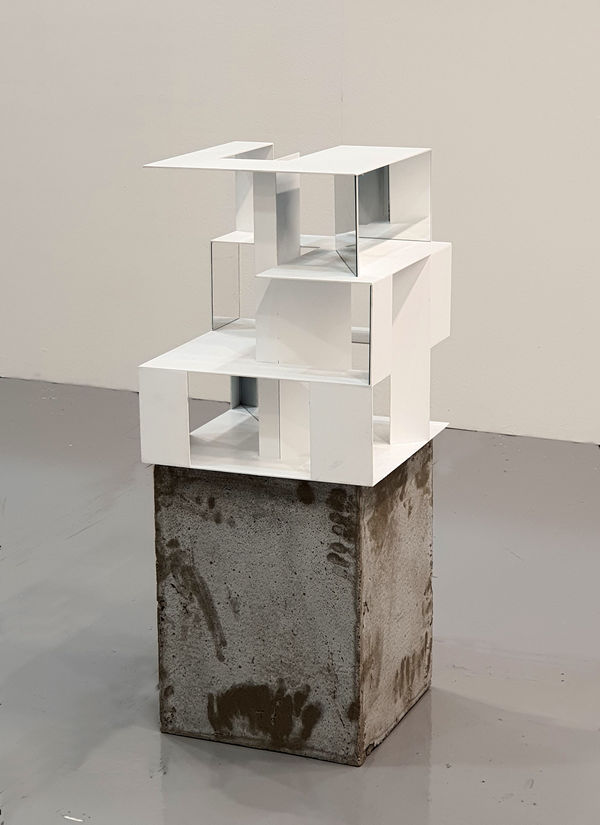
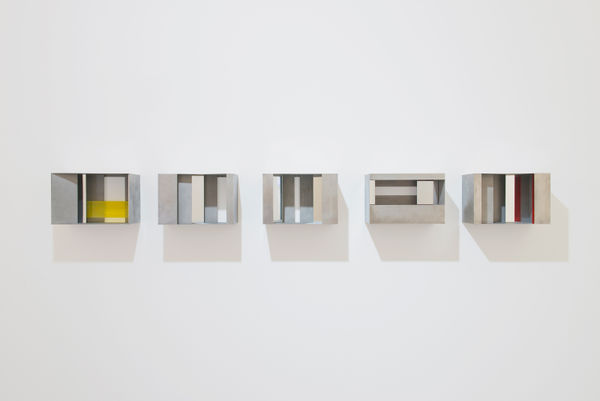
Jeong's abstract formative experiments with light and space continue in the 〈Facade2017〉 (2017), 〈Facade2019〉 (2019), and 〈Facade〉 series. The 〈Facade〉 series are sculptures with cubic structures lined up side by side, each bearing various structures and color planes, abstracting the formative relationships between spaces and light.
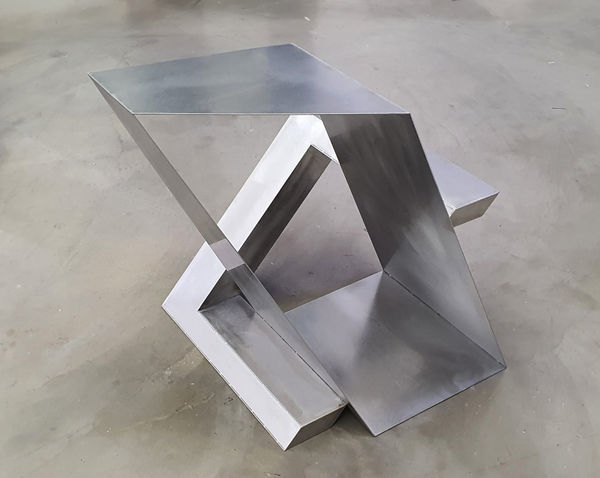
Immersed in the interaction between light and space, Jeong aims to materialize light itself in the 〈Curved Lights〉 series (2021~), 〈Metaphysical Star〉 series (2021~), and others. His work, which began with an interest in light from his early experiences in Germany, seems to return to light itself.
For Jeong, light is both an 'abstract idea' and 'others.' It is transcendent, eternal, and a strange being that passes by the others around him, the social system, and the interior.
-
Sculptures
-
Awards and Selections
Jeongju Jeong has participated in residency programs such as Ssamzie Studio (2003), National Goyang Studio (2006), and Seoul Art Space Geumcheon (2009), won awards such as Jungerwesten 2001 (Kunsthalle Recklinghausen, Germany), the Bergische Kunstausstellung (Museum Baden, Solingen, Germany), 2010 Artist of Today (2010, Kim Chong Yung Museum, Seoul), and was selected as a support artist by CJ Cultural Foundation in 2021.
-
Participated Art Fairs
-
Hive Art Fair 2026
Magok CoexThings Left Behind, Things Yet to Come Things Left Behind, Things Yet to Come looks at the present as a point where traces of the past overlap with possibilities that... -
Frieze Seoul 2024
GalleriesGallery Chosun participates in Frieze Seoul 2024 for the first time, presenting works by Min Sung-Hong, Ahn Sang-Hoon, and Jeong Jeong-Ju . Under the keyword “symptoms of memory loss,” the... -
KIAF 2022
Coex 2 - 5 Sep 2022 -
Kiaf 2021
Coex -
Art Busan 2021
-
SOLO SHOW: 복덕방(福∙德∙房)
Organised Art Fair 1 - 5 Dec 2021
-


![[Maison Galleria] Lights of Shadow, Jeong Jeong-ju](https://static-assets.artlogic.net/w_600,c_limit,f_auto,fl_lossy,q_auto/ws-artlogicwebsite1960/usr/images/video_entries/main_image/47/maison-galleria-lights-of-shadow-jeong-jeongju.png)