Membrane: An Gyungsu
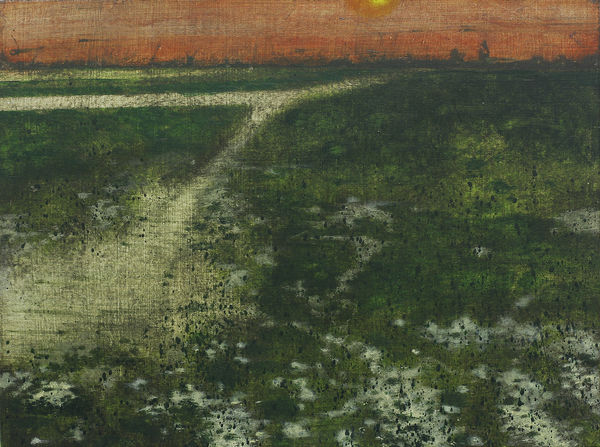


The Membrane Where Sensory Osmosis Occurs
What
“I am no longer curious about the thing he paints.” Critic Kim Hyun-joo wrote this about An Gyugsu (Kim Hyun-joo, “그 사이” 『An Gyungsu Solo Exhibition Catalog On the Way』, MMMG, 2015, p.2.) Of course, she meant that, having observed the artist for a long time, she now knows exactly what he will choose to paint. But the sentence also seems to capture the essence of An’s work.
Instead of saying, “I am not curious about what he paints,”, she said, “I am not curious about the thing he paints.” This phrase felt like a hidden key. What exactly does An paint? It is not hard to identify the subjects in his paintings: stones, forests, trees, buildings, empty lots. These places exist in reality, and most titles clearly reflect their subject. He even takes his finished painting back to locations he painted and photographs them in place (《빈 터》(2015)). It is as if he wants to prevent viewers from imagining hidden meanings behind his depictions, bringing the subjects directly before our eyes with words and photographs.
Why then does An Gyungsu paint these things? The specialness of the everyday? Praise for the ordinary? Compassion for the worn and old? If you detect such a warm sentiment in his view, it would be too optimistic. A gloomy concrete building beyond rust-stained bushes (《슈퍼마켓》(2016)) or a flower bed covered in trash with neon decorations (《전야》(2016)) can appear as apocalyptic or ruinous landscapes. Yet, works like 《분홍 나침반》(2015) or 《매운 구멍》(2015) reveal a dry, formal interest, suggesting that labelling all of his works as simply “melancholic” would be an oversimplification.
So why does he choose these scenes? Let’s reframe the question. Can what An paints be called a “thing”? Conventional vision often separates objects from their background and calls the extracted “thing” an individual object. We tend to see objects as material forms confined within outlines, assuming the world is made up of these discrete objects interacting. But in An’s gaze, the object does not immediately stand out.
In 《빈 터》(2015), the most striking visual difference comes from the lines that cross the canvas diagonally, dividing smooth surfaces from rough weeds. On either side of this boundary, the intensity differs. There are differences in uniformity, artificiality, and solidity. These differences became visible only after the place had undergone certain processes over time, such as weed seeds pushing through cracks and growing.
In other words, the landscape did not initially consist of distinct, impressive objects. Over time, through repeated processes, differences became clear, forming boundaries that drew attention to objects and their environment.
Thus, objects did not exist independently at first but emerged as noticeable only through An’s perception. Here, an object becomes an object only in relation to its environment across a boundary. This is not simply an “individual” but an “individuation.” Yellow defines black as a line (《검은 선》(2015)), and the contrast with darkness highlights the presence of grass (《밤잔디》(2015)). When two sides have topological differences across a boundary and acquire individuality through contrast, this permeable boundary is called a membrane in biology.
The Multiple Coordinates of the Membrane
When An Gyungsu chose “Membrane” as the title for his exhibition, it felt both surprising and fitting. Yet there was no need to explain the philosophical implications of the concept to him. In his paintings, membranes were already spread across multiple axes, and An perceived their properties with greater sensitivity than any biological, philosophical, or aesthetic explanation could convey. He could read and interpret the membrane from many angles.
First, he regarded each of his paintings as a membrane formed by continuously transmitting his perception through a part of a landscape. This perspective is most evident when he takes the painting back to the place it depicts and photographs it there. As he writes in his notes: “Returning to the landscape that became a painting and becoming part of it draws attention to the place. The gaze does not remain in the painting itself but extends into the place, stirring it. Becoming a temporarily placed, discordant layer of the landscape without adding any further meaning is a humble attempt to maintain and relate to even a fragment of it.”
At first, I worried that An Gyungsu’s photographs might be seen as a beginner’s attempt to question the genres of photography and painting, or as a way for the artist to show off his skill. I even heard people suggest that he focused too much on “painterly technique”. However, as his notes show, he was not concerned with the medium of photography itself. Rather, he seemed to be seeking the simplest way to show the relationship between the original landscape and his canvas.
His paintings resemble parts of the landscape, but they contain only the elements extracted through a kind of “osmosis perception”, or, conversely, include elements he added himself; like the paint he sprinkles across the canvas. With the canvas as a membrane between them, there is a temporary phase difference between our experience of the painting and the actual landscape.
Like all painters, or as all painters should, An also reflects on what painting means in a time overflowing with visual media. Yet, he seems less concerned with other media than with the relationship between his painting and the world. While each of his works is a membrane in itself, this quality as a membrane is especially evident in close-up views in works like 《가파른 땅》(2015) and 《기둥2》(2015)
Another type of membrane that An Gyungsu focuses on appears when two very different spaces meet within the same frame. In addition to works like 《검은 선》 and 《밤잔디》, a series of runway painting show these membranes between spaces. Imagine a plane descending: the patchy ground begins to separate into the runway and its surroundings 《활주로2》(2015). When the plane has landed and speeds along the ground, the view from the window makes it seems as if two smooth surfaces meet along a membrane, though as the plane slows, the difference in texture becomes more pronounced (《활주로1》(2015)).
Every small red circles marked on the runway, meant as landing indicators, appear to pop out from the surrounding environments 《분홍 나침반》, clearly showing the membrane as a boundary. Smooth columns, metal rods, broken concrete slabs, and holes amid rough backgrounds are similar examples (《쇠막대기》, 《쇠기둥》, 《무너진 돌》, 《반듯한 구멍》, 《메운 구멍》, all 2015). These membranes are not always smooth; the boundaries can be uneven and sometimes appear and disappear as temporary lines.
Another way membranes appear in An’s paintings is as multiple layers stacked on the canvas. In his recent works, these layered membranes are especially prominent. In 《옥상》(2016), and 《슈퍼 마켓》, a membrane of bushes or trees covers the membrane of a building. In 《장막》(2016), a sparse membrane of electrical wires overlaps a construction tarp and the partially hidden building behind it. In 《전야》, a membrane of coloured fairy lights overlaps a membrane of tangled branches, a membrane of the road, and even membranes made of scattered trash.
Interestingly, these membranes are not always clearly separated in space. Sometimes they are so mixed together that it is impossible to read any coordinates. An Gyungsu separates and “discerns” these membranes through visual osmosis. The most complex example appears in 《정물화》(2016), where membranes are tangled with piles of scattered trash and miscellaneous objects. Before this image, which cannot be separated spatially, we face membranes full of holes that have been extracted solely through colour and texture.
Sometimes, multiple types of membranes appear together. A representative case is 《하얀 어떤 것》(2015). A vague membrane divides the top and bottom of the frame and an unidentified “white thing” floats above the dark upper portion. As always, it is not important to ask what it is. Even here, it is the act of seeing that penetrates and passes through the membranes. The eye moves freely across spatial vectors, extracting the membranes.
Individuation in Painting
Watching An persistently and rigorously devote himself to painting makes me feel both regret and a bit of shame that I lack the critical ability to even place his work at the corner of the grand question, “What is painting today?” As mentioned above, An focuses solely on the relationship between his senses and the world, seeming unconcerned with where his work might fall within the history of painting. Sometimes, it is precisely this attitude that allows one to truly feel what painting is.
Unlike other art forms that survived by systematically rejecting previous artistic trends, painting has endured by distinguishing itself from the world while remaining alive. Seen this way, the reason this long-standing medium has survived in today’s chaotic oversaturated media environment may be that it does not harden into a rigid “individual” protected by a tough shell. Instead, it continuously accepts temporary, fluid, and permeable definitions while differentiating itself from the environment, a process we can call “individuation”.
An Gyungsu’s paintings may function like cell membranes in the process of painting’s individuation, filtering and extracting images as the medium sustains its own life. Through his subtle sensory “osmosis”, Ahn actively selects and channels the elements that nourish the survival of painting.
An Sohyun (Art Critic)
Translated by Gallery Chosun