Moving : The Green Ray: Eun Jung Kim


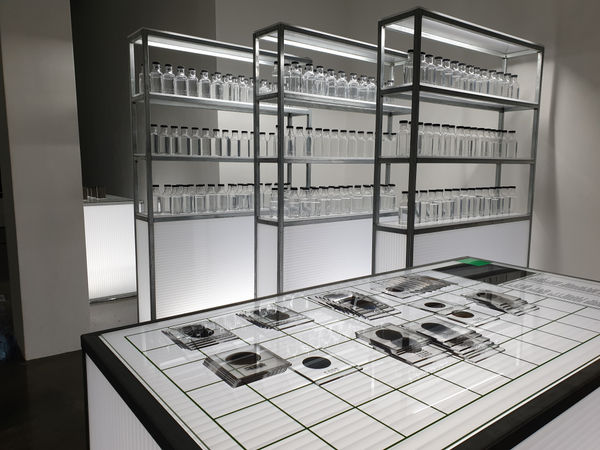

《Moving: The Green Ray》 takes its title from Éric Rohmer’s film The Green Ray. In the movie, the protagonist Delphine is disappointed when she cannot spend the summer vacation she had hoped for, and she walks along, lost in her thoughts. By chance, she finds a green spade card, which to her represents a bad omen, a jinx. As she continues walking she hears about the green ray in passing in the conversations of elderly people. On her way home, after the trip, she finally encounters the green she had sought to avoid. She witnesses the fleeting green light beyond the horizon, alongside people making wishes upon it. It is in that brief, momentary encounter that one realises how deeply a single instant can influence life.
I, too, have experienced many green signals. For example, a bottle of water that quenches thirst, tiptoeing on the street to avoid stepping on cracks, or wanting to assign meaning to a single fallen leaf. Perhaps, as time passes, the reason we create our own signals of fortune even in ordinary days before important events is the uncertainty of the future. Or perhaps it is because we understand that life is never made up only of good days. Regardless, life goes on, repeating the journeys we must and want to undertake. The artist’s mapping work is the practice of unfolding these paths and walking toward them.
Eun Jung Kim’s artistic journey prompts the question: where are we trying to go? The artist walks, thinks, imagines, and discovers. For her, movement is a momentary escape from the repetitive cycles of daily life and habitual patterns. Within this departure, inspiration arises, and the process of surpassing limits repeats itself, reflecting on both the places he has left behind and the paths he is yet to take. Kim meticulously edits the world according to her own method, based on presence and absence of things, ultimately focusing on what remains. In this way, she has mapped her surroundings through her subjective system of perception.
Although her mapping practice, sometimes referred to as counter-cartography, is grounded in approaches to geography and environment, its uniqueness lies in how the results are visualised. While works in the mapping category often take the form of maps and research-based outputs, Kim’s pieces reach the viewer on a sensory level. This sensation arises from the interaction of moving sculptural forms at varying speeds with the structured sounds and images emanating from video, producing a visual experience akin to transforming subjective data into a composition of sculptural forms. This quality is what sets Eun Jung Kim’s work apart from other mapping practices, which may share visual similarities but lack this distinctive synthesis of perception, movement and visualisation.