Wrinkles in repeated sentences: Sanghoon Ahn
-
Video
-
-
Press Release Text
Painting in the age of Images
To reach this paper, you had to pass through two doors. One door was opened from the outside to let you in, and another stood right at the foot of the stairs. Once you take the paper in your hands, another door appears before you. These recurring doors twist the expected space once more and make time flow differently than anticipated.
Ahn Sanghoon’s solo exhibition ⟪Wrinkles in Repeated Sentences⟫ is divided between the basement, showing works completed in Germany several years ago, and the second floor, presenting newly created pieces from this year. What the multiple doors emphasize is not the gap of years between the two groups of works, but the exhibition’s uniquely specific time and world.
Within the world of image, time becomes active. In this world, time is plastic. Plasticity refers to a state that is fixed yet assumes movement. Time in the image world is captured and accumulated, but it also transforms depending on where the gaze moves. Even within a single canvas, the eye discovers and travels across different colours, strokes, and textures, creating trajectories of overlapping and dispersing time. Similarly, as the gaze shifts from one canvas to another, it generates new time. In the same way, the artist operates the time of the image world within the exhibition space, inserting gestures outside the canvas to mix paintings made years ago (memory) with the present site (imagination).
In 『Praise of Superficiality』, Vilém Flusser describes time in the image world as magical; where the dead can come alive again and death can coexist within life. In contrast, he locates time in the world of language differently. In the language world, time is considered linear, created through separation and discontinuity. For example, in words like “yesterday” or “that day”, and the sentences that follow, time links ideas such as “closure and what comes next” or “death and a new beginning.” In the language world, time moves away from the concreteness of experience, becoming disjointed and increasingly abstract. In short, unlike the language world, the image world constructs time as concrete, cyclical, fluid and magical.
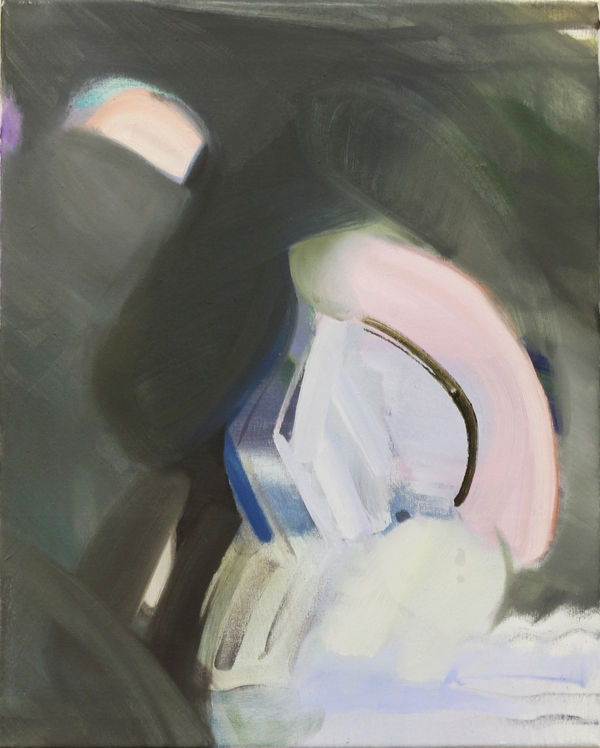
Ahn’s paintings belong not to the world of language, but to the world of images. Anyone who has lingered before his work will have experienced the movement of images: shapes erased, colours on the canvas tangled, and suddenly a black stroke or a purple plane appears. The pictorial elements that create this experience do not predict what comes next or suggest closure; instead, they generate ongoing imagination and shifting gazes. As a result, even if a canvas carries a date or a sentence (title) that might define it, viewers do not acquire the clear, segmented meaning (connotation) characteristic of the language world. Saying that his painting belongs to the image world is not redundant, because painting could also operate as part of the language world. Yet Ahn consciously experiments with the (im)possibility of painting belonging to the language world while deliberately choosing to move toward the image world.
Consider the recent tendency in painting toward mechanical automatism: image-making that follows the algorithms of specific platforms or software, or that operates through random collection, editing, and reproduction. These approaches radically undermine linear time and fixed meaning, demonstrating a contemporary return to the image world rather than the world of text. Ahn’s practice is closely aligned with this. He arbitrarily collects letters found through Googling and combines them to form titles after completing a work. He starts painting from discarded images stored on his phone, or draws concrete shapes or letters only to erase them later.
Eventually leaving the world of text, he presents the unfamiliar images and gestures before his eyes. The movement, oscillating between improvisation and mechanical automatism, accumulates on the canvas and continues even in the finished work. With the same logic, the artist moves around the canvas from different directions while painting, and later views the completed surface from multiple orientations. Ultimately, when he can find a satisfying state regardless of how the canvas is turned, the image once again escapes the linear world of language. The potential to open up from any perspective or direction gives the canvas a tangible, physical concreteness.
The exhibition title, the numbers indicating when the works were made, and even the sentences in this introduction are neither the starting point nor the destination of the works. What the eye encounters; lines crossing the canvas, forms rising in blurred clusters, gestures spilling across the wall, bare canvas peeking through pale yellow, layered material textures, brush marks following split bristles, one colour next to another, wide fields of colour punctuated by sharp lines, reveals a state in which meaning cannot be grasped, or has disappeared, or oscillates between two or more possible meanings.
This state is not abstract but presented as a tangible reality before you. By being held in that concreteness, you are drawn to linger longer in front of the painting. In the unfolded world of images, the trajectory of the gaze and the flow of time recomposes the painting itself.
Written by Hur Hojeong -
-