Seeming of Seeming: Min Sunghong
-
Overview

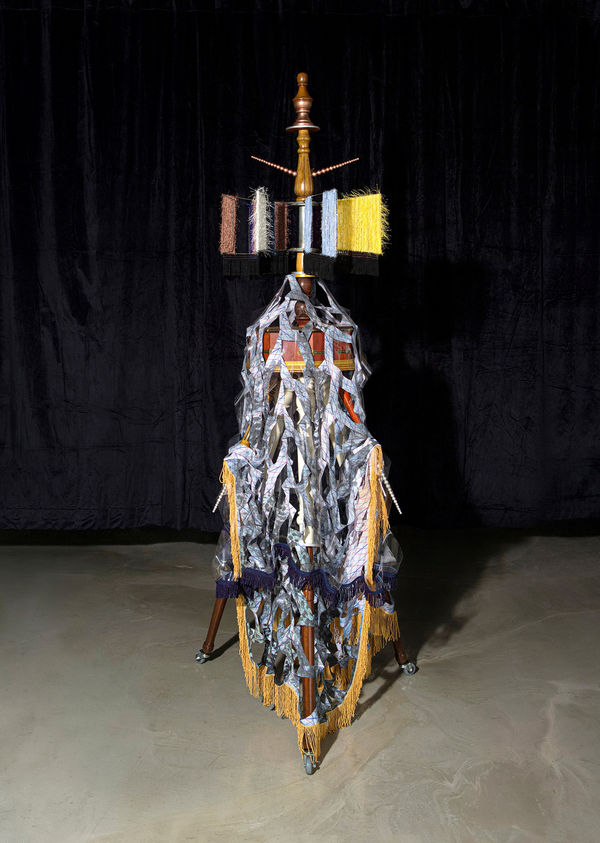
The body is a living form made from the reshaped experiences of people and nature. The structures and outside forces around it cover or decorate it like a mask. Its essence is the set of organs, which are linked fragments inside the outer body. These organs hold a natural idea and a fixed order. They can be seen as the agents that shape society.
Eighteen linked objects gathered from different places form a structure that suggests an organic body and a shifting landscape. The thin layer around each object hides or blurs the decorated inside, like skin that connects the outer and inner sides of the body. The staged scenes are temporary. They show fragmented individuals looking at one another, recognizing one another again, and accepting one another.
-
Video
-
-
Press Release Text
Text: Taehyun Kwon
Title: To thread, you must make a hole
Min Sunghong threads things together. He often takes apart furniture left on the street and joins it with other objects, or folds and stitches discarded paintings. A lot of his work involves threading. Threading is, at its core, a way of joining things. It is not simple attachment, but rather, creating holes and tying things through them. This is the same when stringing beads, sewing with thread, or using a stapler. Threading never leaves an object as it is. It damages the material. It breaks something before it connects. It makes a hole in a smooth surface and tears the layer that once marked the line between inside and outside, between what is held within and what is shown. Only after making this hole can something be threaded.
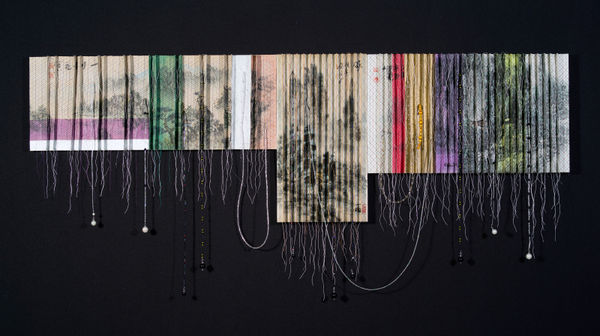
In the series ⟪Exercise for Variability⟫, made by folding discarded landscape prints layer by layer, thin threads hang from many points. When you follow the loose threads that stretch past the frame, you see stitch marks inside the raised folds. Because the threads spill out loosely from the needle holes, the physical state of work stands out as much as the image itself. Vertical, horizontal, or diagonal folds create ridges in the picture. These folds give the image real depth and let a flat surface show both its front and its side at once. In many ways, the folds make the work operate in three dimensions.
The folds also make the viewer move. When you look at ⟪Exercise for Variability⟫ from the front, you can still tell it is a landscape print, even though many areas are hidden by the folds. This is because people already carry a schema of landscape painting in their minds. We often see things as we expect them to be. But if you follow the loose threads coming from the needle holes and trace the curved, folded surface up close, the natural flow of the mountains in the picture breaks apart. The sense of the landscape scatters as the folded sections come into view.
The viewers move and feel the depth of the folds, meeting the ridges on the surface with the body. Here, as with threading, the folds invite another look at what is inside and what is outside. It is also possible to approach this through Deleuze’s idea of the fold, which takes up this question in a more layered way. The fold, which appears in many forms in his books, works as a central image in this thought. He compares the play between the latent and the actual to a fold. To sense the chance of unfolding in a fold, or to notice the fold that stays within what has been opened. Even without working through such complex ideas, the folds in front of us show that one side’s bend becomes the other side’s opening. A fold holds an opening, and what is opened still contains a fold.
From this view, the outside is not fixed. It becomes the movement of folds that make an inside. A fold creates both an inner side and an outer side at the same time. In ⟪Exercise for Variability⟫, the question of inside and outside appears not only through the folds but also through another element the artist adds by hand. Min draws a mesh of horizontal, vertical and diagonal lines over the found landscape print. This mesh is a form that appears often in his work. Critic Kim Hong-gi once described a similar mesh in ⟪Fence Around⟫ as a “self-contradicting fence”, as it blurs what is inside and what is outside.
It blocks, yet you can still see through it. It is pierced, yet it makes you aware of the surface boundary. Its visibility is cloudy but present. It works like a window screen, a device that keeps things out while allowing passage. And with a slight shift in viewing angle, the mesh reveals clusters of small holes made by thin lines woven together.
This mesh, or grid, as Rosalind Krauss sharply noted in relation to modernism, has no hierarchy, center, or curve. It has often been seen as a sign of pure indifference and complete lack of purpose. Because of this, it is linked to modernist ideas such as the autonomy of art.
The grid may look like it shows nothing, yet this is not true. The grid is a divided version of the very surface it tries to represent. Min Sunghong places a mesh on the surface of the image to make that surface visible, then folds the surface in a physical way. Another point is that the image he works with is a landscape in the style of East Asian painting. Such landscapes, except in the case of true-view painting, repeat an imagined scene. They belong to a visual system completely different from Western landscape painting, which is tied to the idea of a modern subject who discovers a view in empty space. Through this method, Min creates a surface where different visual systems pierce one another and become threaded together in a complex way.
This mix of different elements does not stop with the layered visual systems of the surface. In the corners of the paintings, several seals mark the author. He stamped his own name, using a typical seal for East Asian painting, onto the found images. The overlapping seals thread together and pierce the boundary of authorship. The ⟪Exercise for Variability⟫ series did not originally have wooden frames. Recent shows added frames, but in earlier displays the works were placed directly on the wall. Without frames, pieces holding different scenes linked to one another in many ways, create a new landscape on a different scale.
Mixing objects from different systems is not limited to the ⟪Exercise for Variability⟫ series. Min also gathers discarded objects from his surroundings and threads them together like beads in the ongoing ⟪Dasirak⟫ series. From this sculptural approach comes the ⟪skin_layer⟫ series, where three-dimensional forms are covered with mesh made of fabric or vinyl. The mesh, sometimes resembling military camouflage, has holes that allow one to see inside from the outside and outside from the inside. This structure echoes the earlier themes of threading, folds, and grids.
The camouflage in ⟪skin_layer⟫ also revisists earlier landscape works, which had been presented like parachutes, by puncturing them with holes and re-presenting them. Through this method, Min threads his own works together conceptually and materially.
Among Min’s works that rework decorative landscapes, ⟪Window⟫ connects interestingly to this discussion. In it, he tears the landscape paintings and either sews the edges with thread or fastens them with a stapler. Through the rips, the white flat surface of the support beneath is revealed. These cracks make visible the material structure that underlies and supports the system making the image work. This can also be compared to the use of sutures or staple devices to close a torn or damaged area of the tissue. A tissue which could jeopardize the integrity of the surrounding area if torn open. The gap in the surface, which exposes the underlying support structures, is analogous to a serious injury through which internal components could be exposed. However, once properly sealed, the wounds typically heal over time, resulting in the formation of a scar. This surface is one that accommodates and integrates with cracks, wounds, and external elements as part of its natural healing and adaptation process.
Min Sunghong continually threads together things from different worlds; surfaces that reveal both inside and outside, skin, layers, meshes, and the very act of threading itself. In his work, which weaves things together, the boundaries that separate subject from object or inside from outside disappear. Moreover, these connections extend beyond a single work, linking different materials, the audience, and even the world outside the artwork. Once again: to thread, you must first make a hole. These holds, in turn, will pierce the world itself.
Public Art , 2022년 July: p.124, 125.
Translated by gallerychosun -
-
-
2018, Fence Around, CR Collective, SeoulIn ⟪Fence Around⟫, Min Sunghong performatively unites his previous works while focusing on the contemporary diaspora. As he notes, the work “reveals identity, class, and the ambiguity of their boundaries... -
2020, Drift_Drifting Object, Wumin Art Center, CheongjuIn the exhibition ⟪Drift_Drifting Object⟫, the artist explores the potential of objects to symbolize beings whose identities have become unclear or uncertain due to changing situations and perceptions. This work... -
2022, Two Mountains, Two Moons, and Water, Bongsan Cultural Center, Daegu⟪Two Mountains, Two Moons, and Water⟫ seeks to present ways of seeing and physically engaging with the increasingly diverse landscapes and situations of contemporary life. Using fluid, adaptable structures and... -
2017, Rolling on the Ground, Mullae Art Space, SeoulThe title ⟪Dasirak (多侍樂) ⟫, comes from the traditional Dasi-raegi funeral ritual. It was a celebratory practice meant to ease the grief of the bereaved. In old customs, mourners would... -
2023, Receiver and Transmitter, Gallery Bundo, DaeguThe process of collecting objects and bringing them into my own space reflects how the question of boundaries; what is inside and outside, intervenes deeply in personal life, shaping relationships...
-