Min Sunghong
-
Biography

The varied and theatrical practice of SungHong Min is filled with uncanny absurdities in detailed installations that meditate on what is visible and what's hidden in the contemporary social landscape.
Early Years
SungHong Min was born in 1972 in South Korea. He graduated from Chu-Gye University for the Arts, Seoul, with a Bachelor of Fine Arts in 1999. Five years later, he received his Master of Fine Arts degree from the San Francisco Art Institute.
For both his undergraduate and graduate degrees, SungHong Min specialised in painting, however, even early works such as The Island (2002) include sculptural elements. Over the course of his career to-date, the artist has retained a painterly approach while working predominantly in the three-dimensional.
-
Artworks
SungHong Min's sculptural vocabulary spreads out into a diverse range of intricate and often site-specific approaches. Gathering together items generally regarded as detritus to forge new connections and meanings between objects, the artist reflects on visibility and invisibility in photo collage, drawing, sculpture, and installation.
The 'Overlapped Sensibility' series
The concept of overlapping is key, both conceptually and materially, to SungHong Min's practice. In his 'Overlapped Sensibility' series, this motif is combined with his recurring use of the figure of the bird as an allegorical stand-in for the human social ecosystem.
In Overlapped Sensibility: Imbued (2015), a bird stands like a weathervane at the top of an illuminated roof structure, while a flock huddles inside. A birdhouse cast from a human home, the structure is architecturally reminiscent of medieval churches.
In Overlapped Sensibility: Carousel (2015), the birds reappear as ceramic bird heads resting atop wooden plinths of different shapes and sizes. The collection of figures is perched within a white motorised carousel, in reference to writer Haruki Murakami's description of the carousel as a metaphor for the fixed cycles of life, on which humans are trapped until death.
-
-
-
-
-
Exercise for PlasticityExercise for Plasticity is a work in which the artist reconstructs landscapes from traditional landscape paintings collected around the spaces of their everyday life, placing them on ceramic forms that resemble pillows.Landscape painting does not depict reality itself, but rather an imagined, conceptual ideal. In this sense, it symbolically reveals how we perceive and relate to the environments and situations that surround us.Through this work, the artist distances themselves from dominant interpretations and perspectives on landscape, encouraging viewers to reconsider landscape as something variable and fluid.When an object receives external stimuli, it reveals two opposing properties: the tendency to resist deformation, and the tendency to preserve the deformation once it has occurred. Human cognition, too, has a certain fluidity, changing its functions in response to surrounding environments and lived experiences.Each work reveals the delicate surface boundaries that divide the ideal and the real within our experience. During the process of slip-casting, the ceramic structures become deformed and cracked through contact with the body resting upon them. Through these altered forms, the work tactilely expresses sensations that arise in the process of recognizing absence, perceiving situations, and overcoming anxiety toward the unreality embedded in such acts of acceptance.
-
-
'Drift' works
The connections and divergences between the natural and the constructed landscape represents another cornerstone of SungHong Min's practice. Through a re-examination of standard interpretations of landscapes in the 'Drift' series, the artist seeks to reintroduce an uncertainty to the viewer's perspective.
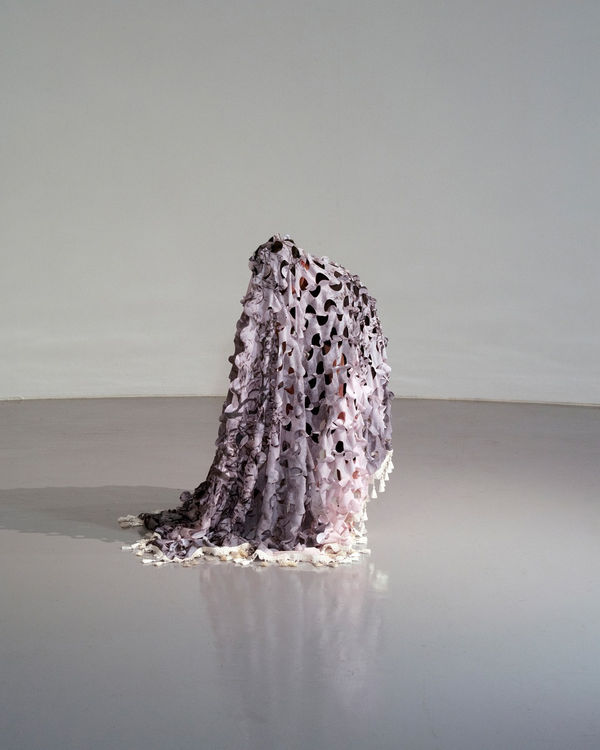
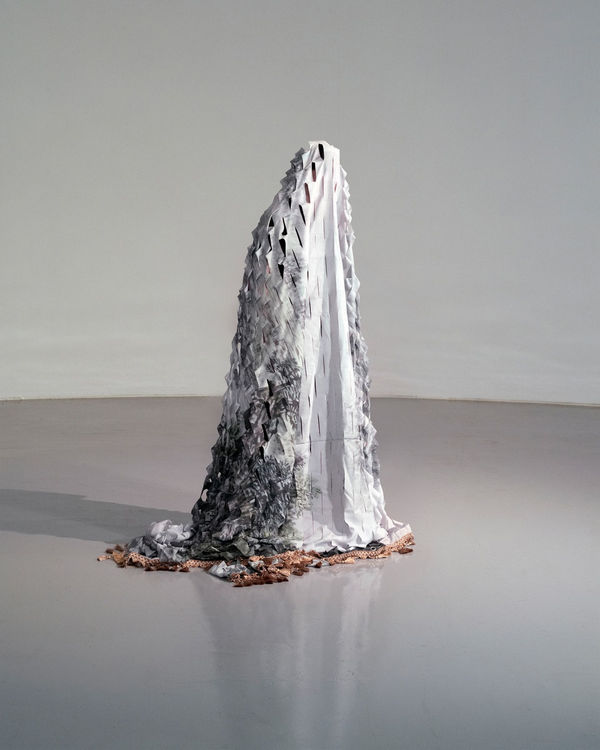
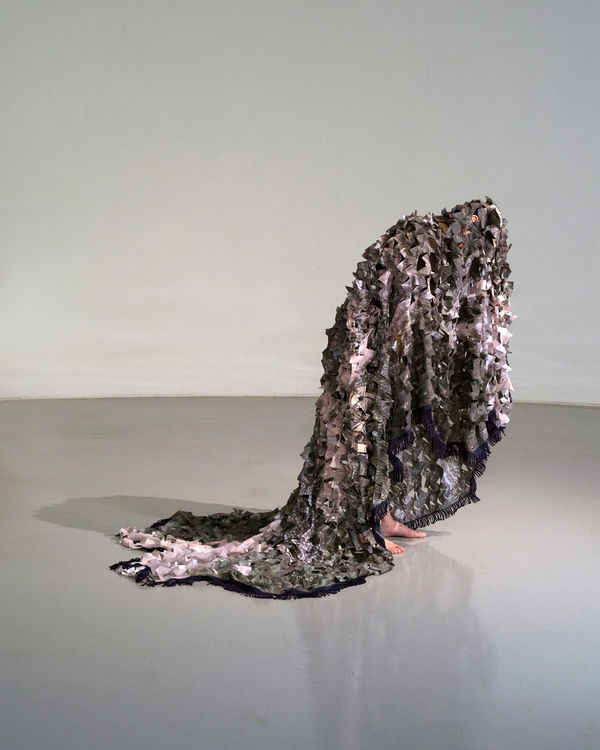
In Drift_Atypical (2020), SungHong Min has rearranged and combined landscape painting fragments into tent-like structures. These large, suspended shapes are covered in a grid and ringed by tassels, pulling them between the worlds of the clinical, the domestic and the majestic.
For Drift_Exercise for variability (2020), Min has gathered discarded landscape paintings, folded, sewn, and layered grids on top, offering a literal and conceptual representation of the landscape.
-
-
Circulating Body_Antenna Bird
Among the Circulating Body series, Antenna Bird is a human-shaped installation work combined with a crystal radio. The work captures surrounding radio waves and converts them into sound without using electricity. It functions as both a technical and metaphorical device that mediates flows emitted from somewhere yet not clearly perceived, or signals remaining in the gaps of sensation. Min explored the invisible currents within the complex networks of relationships that connect individuals, groups, and society, while also considering the senses that deviate from those flows.
-
-
'Skin_Layer' series
Sunghong Min collects belongings discarded in the course of urban development and relocation, combining them into spectral structures and installations. His work gives these residues new forms and lives, preserving traces of past use while commemorating their reincarnation.
-
works on canvas
-
Exercise for Painting
Objects pulverized with a wood chipper are reduced to small fragments and spread across rough painterly surfaces, like landscapes arranged within a grid. Lines drawn with ballpoint pen and chalk powder mark boundaries, divisions, and structural references. On the canvas, chalk powder becomes a medium that metaphorically evokes administrative and institutional frameworks, while the resulting surface forms a fluid and uncertain sensory terrain. In Practice for Painting, the fragments are not simply arranged, but accumulated in layers across the canvas. Beneath paint applied with a roller, they rise like reliefs, giving the surface a sculptural presence. The uneven canvas invites viewers to read and rearrange these scattered clues.
By placing fragments from different spaces and times onto a single surface, Min reconstructs multiple layers of time. The repeated traces of covering, folding, and accumulation suggest how time permeates objects, and what new temporalities emerge when those objects are displaced from their original context.
-
work on paper
-
Exercise for Drawing_Fleck
In the Practice for Drawing series, pulverized fragments of objects are scattered across flat surfaces divided by lines made with multicolored ballpoint pens and chalk powder. A chalk line is a tool commonly used in architecture and carpentry to mark straight lines, functioning as a reference line for determining the position, boundaries, and divisions of a structure. The grid drawn with ballpoint pen serves as a metaphorical medium for administrative and institutional structures, while the landscape unfolding across it operates as a fluid and uncertain sensory terrain. On the canvas divided by straight lines, the disorderly positioned fragments suggest the place of beings that have deviated from, or been excluded from, the social environment or community. In particular, in Practice for Drawing, a line resembling a laser level crosses the center of the frame, which recalls the format of a Polaroid. While a laser level is used as a tool to divide and segment space in a “balanced” way, Min Seonghong’s line arranges the separate drawings within a spatial grid and connects them side by side, constructing an image of flow rather than rupture.
-
Exhibitions
-
External Exhibitions
-
2024 ⟪Gyeonggi Artist Highlights 2024⟫, Gyeonggi Museum of Modern Art, South Korea2024.7.11 - 9.22 4전시실
-
2023, Receiver and Transmitter, Gallery Bundo, DaeguThe process of collecting objects and bringing them into my own space reflects how the question of boundaries; what is inside and outside, intervenes deeply in personal life, shaping relationships...
-
2022, Two Mountains, Two Moons, and Water, Bongsan Cultural Center, Daegu⟪Two Mountains, Two Moons, and Water⟫ seeks to present ways of seeing and physically engaging with the increasingly diverse landscapes and situations of contemporary life. Using fluid, adaptable structures and...
-
2020, Drift_Drifting Object, Wumin Art Center, CheongjuIn the exhibition ⟪Drift_Drifting Object⟫, the artist explores the potential of objects to symbolize beings whose identities have become unclear or uncertain due to changing situations and perceptions. This work...
-
2018, Fence Around, CR Collective, SeoulIn ⟪Fence Around⟫, Min Sunghong performatively unites his previous works while focusing on the contemporary diaspora. As he notes, the work “reveals identity, class, and the ambiguity of their boundaries...
-
2017, Rolling on the Ground, Mullae Art Space, SeoulThe title ⟪Dasirak (多侍樂) ⟫, comes from the traditional Dasi-raegi funeral ritual. It was a celebratory practice meant to ease the grief of the bereaved. In old customs, mourners would...
-
-
Awards and Accolades
SungHong Min has been the recipient of multiple residencies and awards, including the Pakdongjun Prize (Visual Arts), P.D.J Memorial Foundation, Daegu (2023); the SeMA Nanji Residency, Seoul (2020); and the Woomin Art Award, Woomin Foundation, Cheongju (2019).
Exhibitions
Solo exhibitions include 《Receiver and Transmitter》 (Gallery Bundo, Daegu, 2023); 《Seeming of Seeming》 (gallerychosun, Seoul, 2022); 《Drift_Drifting object》 (Woomin Art Center, Cheongju, 2020); and 《Overlapped Sensibility》, (Art Loft, Brussels, 2018).
Group exhibitions include: 《Grid Island》 (Seoul Museum of Art, 2022); 《Museum Access: Through the Eco-Corridor》 (Gyeonggi Museum of Modern Art, 2022); 《the Gwangju Biennale》 (2018); and 《D.N.A.》 (Daegu Art Museum, 2016).
-
Participated Art Fairs
-
Hive Art Fair 2026
Magok CoexThings Left Behind, Things Yet to Come Things Left Behind, Things Yet to Come looks at the present as a point where traces of the past overlap with possibilities that... -
Frieze Seoul 2025
GalleriesGallery Chosun will take part in Frieze Seoul 2025 , held from September 3 to 6, highlighting artists Sunghong Min, Minjung Woo, and Sooryeon Choe, marking its return after its... -
Frieze Seoul 2024
GalleriesGallery Chosun participates in Frieze Seoul 2024 for the first time, presenting works by Min Sung-Hong, Ahn Sang-Hoon, and Jeong Jeong-Ju . Under the keyword “symptoms of memory loss,” the... -
Art Osaka 2024
Expanded SectionAhn Sang-Hoon and Min Sung-Hong each begin from painting and sculpture respectively, expanding their practices within the field of contemporary art. Their expansion constitutes an experiment in moving painting and... -
KIAF 2022
Coex 2 - 5 Sep 2022 -
Kiaf 2021
Coex
-